Staking
Last updated: April 8, 2026
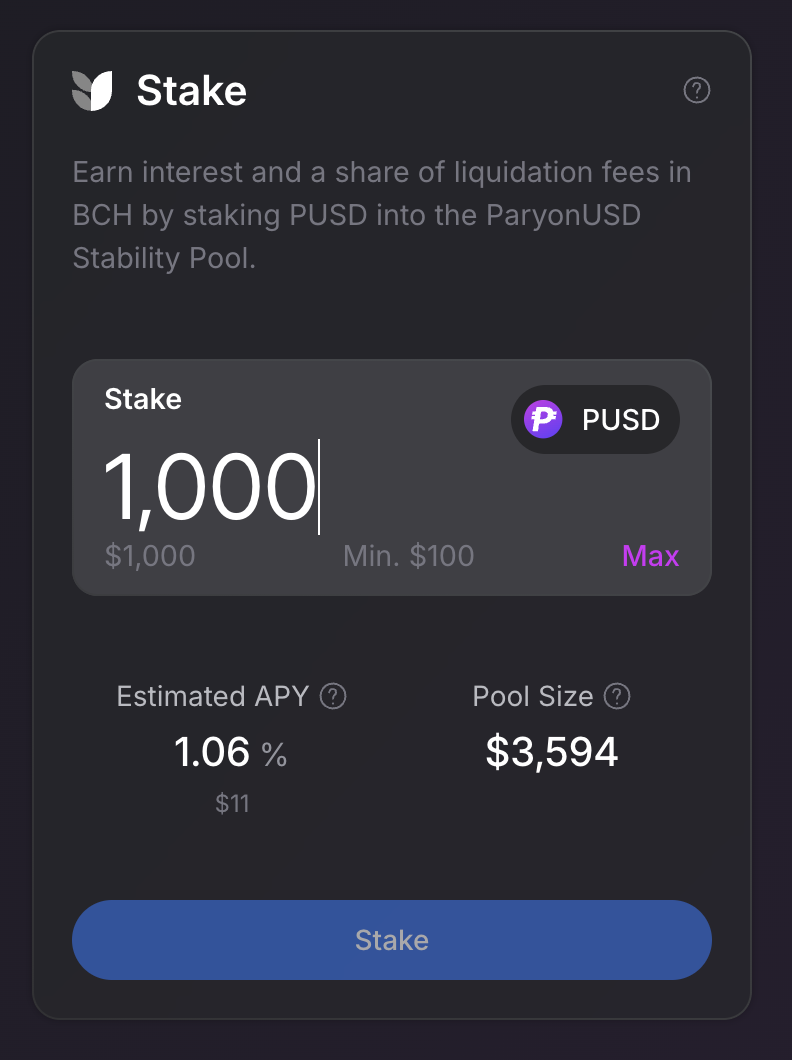
Staking lets you earn BCH yield by depositing PUSD into the Stability Pool. The pool plays a critical role in the protocol: it absorbs bad debt when undercollateralized loans are liquidated. In return, stakers earn a share of protocol revenue.
How staking works
- You deposit PUSD into the Stability Pool
- Your stake earns yield from two sources: borrower interest payments and liquidation profits
- Yield accrues in BCH and can be claimed after each epoch
- Your stake is locked until the next epoch boundary (~10 days) before it can be withdrawn
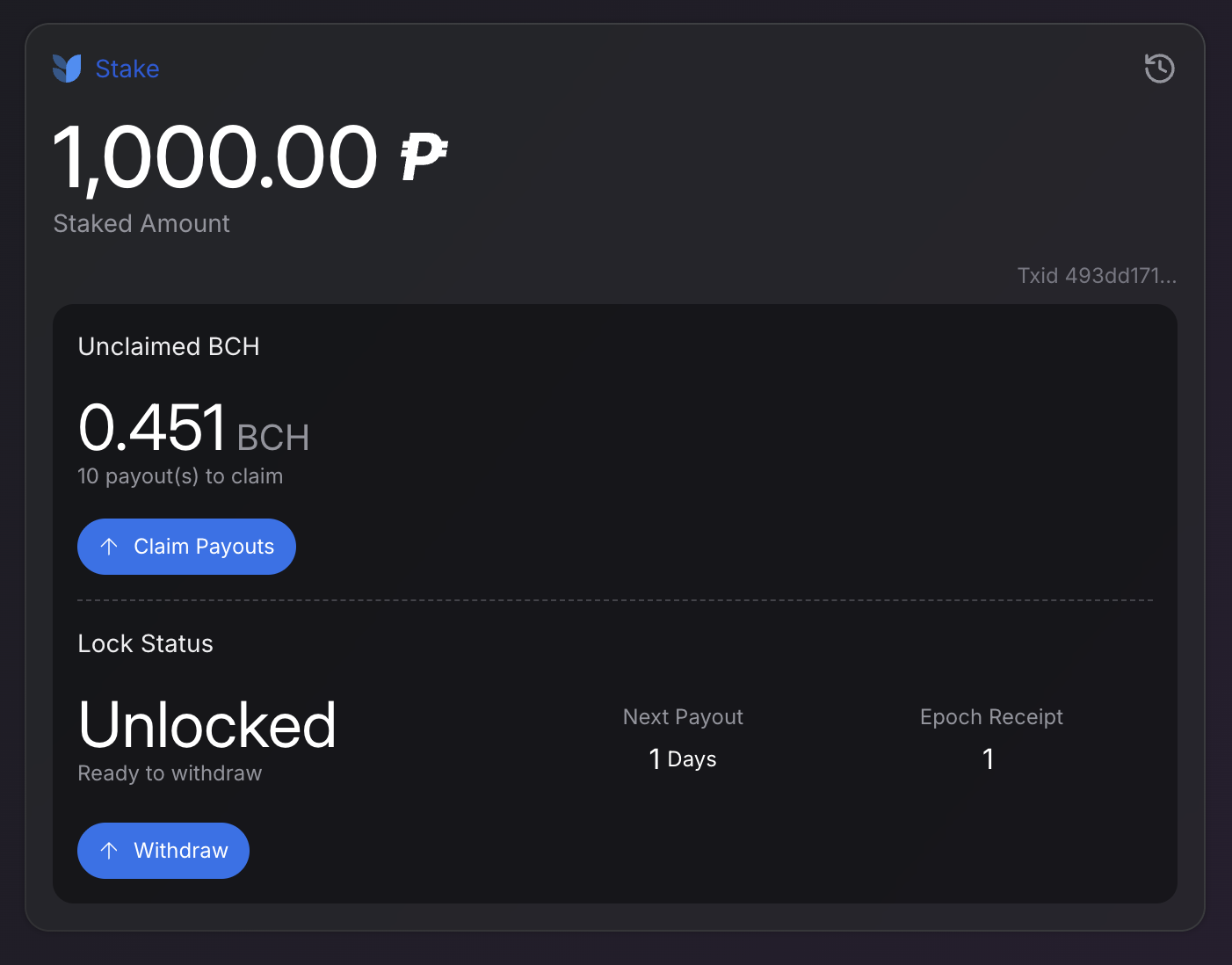
Your stake is represented as a staking receipt NFT in your wallet. This receipt tracks your position and accrued payouts.
What you earn
Staking yield is real and sustainable — it’s paid directly by borrowers in BCH through interest payments and liquidation fees, not funded by token inflation or speculation.
Stakers earn BCH from two sources:
Interest payments (70%) — Borrowers pay interest on their loans. 70% of all interest collected goes to stakers, distributed proportionally based on each staker’s share of the total pool.
Liquidation profits — When a loan is liquidated, the Stability Pool’s PUSD is used to repay the debt, and the pool receives the loan’s BCH collateral. Since loans are liquidated at 110% collateral ratio, the BCH received is worth more than the PUSD spent — the difference is profit for stakers.
APY
The app shows an estimated APY based on the previous epoch’s returns, annualized. This is a backward-looking metric — actual yield varies depending on:
- How much PUSD is borrowed (more borrowing = more interest)
- What interest rates borrowers are paying (higher rates = more yield)
- How many liquidations occur (more liquidations = more profit, but also more risk)
- How much PUSD is staked in the pool (larger pool = your share is smaller)
APY is not fixed or guaranteed. It reflects what stakers earned in the last epoch, not what they will earn in the next one. However, the pool is self-balancing: when fewer people stake, each staker’s share of yield increases, which naturally attracts more capital and keeps the pool well-funded for liquidations.
Epochs and lock periods
The Stability Pool operates in epochs of roughly 10 days. Epochs determine when payouts are distributed and when you can withdraw.
Lock period — When you stake, your PUSD is locked until the next epoch boundary. You cannot withdraw before then. Once unlocked, you can withdraw at any time.
Payouts — At the end of each epoch, earned BCH is made available for claiming. You claim payouts separately from your staked PUSD — claiming does not affect your stake.
Claiming payouts
After each epoch, you can claim your BCH earnings from the stake detail page. Each epoch produces a separate payout that must be claimed individually. Unclaimed payouts remain available — there’s no deadline to claim them.
Withdrawing your stake
Once your stake is unlocked (after the epoch boundary), you can withdraw your PUSD. Withdrawing returns your remaining staked PUSD to your wallet.
Minimum stake amount: ~10 PUSD.
Risks
PUSD balance reduction
This is the key risk of staking. When a loan is liquidated, PUSD from the Stability Pool is used to cover the debt. This means your staked PUSD balance may decrease.
However, you are compensated with the liquidated loan’s BCH collateral. Since liquidations happen at 110% collateral ratio, you receive BCH worth more than the PUSD you lost. In dollar terms, you come out ahead — but your position shifts from PUSD to BCH.
Example: A loan with 100 PUSD debt and 0.25 BCH collateral (worth $110 at liquidation) is liquidated. The pool spends 100 PUSD and receives 0.25 BCH. If your share of the pool is 10%, you lose 10 PUSD but gain 0.025 BCH (worth $11). Net gain: $1 in dollar terms, but you now hold more BCH and less PUSD.
In practice, this matters most during sharp BCH price drops when many loans are liquidated at once. If BCH continues to fall after you receive the collateral, the BCH compensation may end up worth less than the PUSD you lost.
Lock period
Your stake is locked until the next epoch boundary. If you need your PUSD urgently, you cannot access it until the lock period ends. Plan accordingly — don’t stake PUSD you may need within the next 10 days.
Variable yield
Yield is not guaranteed. In periods of low borrowing activity or few liquidations, returns may be minimal. The APY shown is an estimate based on past performance.